A marketplace integration hub runs the selling operation: it publishes the listing, brings the order back and syncs stock and price. The PIM (Product Information Management) handles the product record. The feed manager adapts that record to the format of each media channel. Start with the product record, because the rest depends on it.
Anyone selling on several channels gets pitched three kinds of tools that look the same in a sales deck: the marketplace integration hub, the PIM and the feed manager. All of them talk about "centralizing" and "publishing to several channels." In practice, each one solves a different part of the problem, and mixing them up is the most common way to buy the right tool for the wrong problem.
The integration hub handles the selling operation
The marketplace hub exists for the transactional side: getting the listing to the marketplace and, above all, bringing the order back, syncing stock and price, and tracking invoicing and delivery. The question it answers is "how do I sell and ship across several marketplaces without running each panel by hand?"
The VTEX integration with Mercado Livre is a good example of this role. The VTEX documentation on that integration (in Portuguese) describes paid orders entering the store and the price and stock of listings being updated when they change.
In general, it publishes the product data it receives. If the product record arrives incomplete, the listing goes out incomplete.
The same documentation notes that each Mercado Livre category has attributes that may be required, and that sending a product calls for mapping categories, attributes and variations. If the attribute does not exist in the product record, there is nothing to map.
The PIM handles product data
The PIM exists for the information side: the complete record of each product, with attributes by family, technical specs, texts, quality rules, approval and history. The question it answers is "is my product described completely and correctly, once, for every channel?"
It does not process orders or control stock. It makes sure the product goes out fully described to each channel.
The feed manager handles the translation for each channel
The feed manager sits between the product record and the media and comparison channels: Google, Meta, TikTok, Pinterest and others. It turns the product record into the format each channel asks for, chooses what goes into each one, applies price and rules per channel and points out what is missing before sending. The question it answers is "how does each channel receive my catalog the way it requires?"
On Google, that format is in the Merchant Center product data specification, which marks each attribute as required, optional, or dependent on the product and the country where it is advertised. The path from the product record to the media channels is detailed in how modern feed management works.
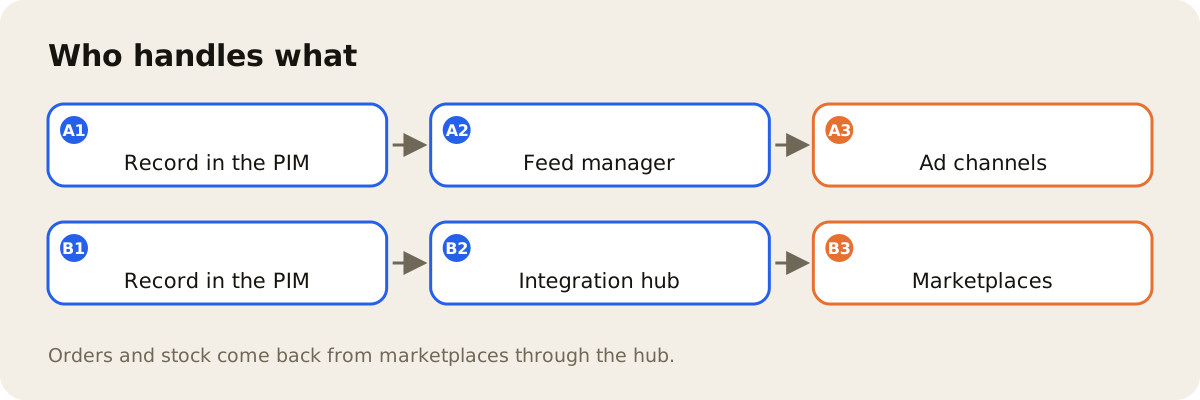
Which problem calls for which tool?
- Orders from several marketplaces handled by hand, stock gaps between channels. That is a hub problem.
- Incomplete products, titles with no standard, wrong photos, each channel with a different version of the product. That is a product data problem, and product data is what a PIM handles.
- Items rejected on Google, an outdated ads catalog, no control over what goes into each media channel. That is a feed problem.
Many operations have all three. The order matters: a hub or a feed manager on top of a poor product record only spreads the problem faster. Fixing the data at the source is usually the step that makes the other two pay off.
For the third problem, the causes of disapproved products in Merchant Center show what to fix in the product record before sending.
Where AdCore Turbo sits
AdCore Turbo brings together the two data layers: the PIM, with the product record, approval and history, and feed management, with publishing to channels, price and rules per channel, and Feed Health pointing out on the SKU the required field that is missing. The photo is linked to the SKU in the DAM. Marketplace orders, stock and invoicing stay with your platform and your hub; AdCore Turbo handles the product data.
The list of channels and integrations is on the integrations page. If your problem is the product record, the signs that your catalog needs a PIM help confirm it, and you can talk to us.