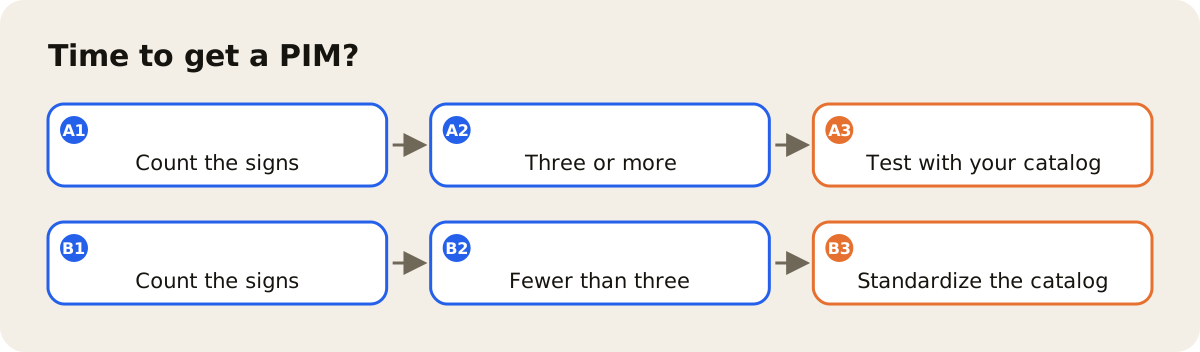
It is worth getting a PIM (Product Information Management system) when product data becomes the bottleneck: the same product looks different on each channel, a new channel means re-entering data and nobody knows what is incomplete. If three or more of the seven signs below describe your routine, it is time to evaluate one.
Every e-commerce operation starts by setting up products wherever it can: in the store admin, in a shared spreadsheet, in the ERP. That is the natural way to start. The problem appears when the catalog grows faster than the way it is managed, and product data becomes the bottleneck for launches, for new channels and for campaigns.
A PIM is the system built for that moment: one place for the complete product record, with rules, approval and output to each channel. Before thinking about vendors, it is worth recognizing the signs.
Seven signs the spreadsheet is no longer enough
- The same product has different versions on each channel. The store title is not the marketplace's, which is not Google's, and nobody knows which one is right.
- A launch spends more time in data entry than in negotiation. The collection is ready, the photo is ready, and the product waits weeks to be complete.
- Opening a new channel means re-entering the data. Each new marketplace becomes a spreadsheet project.
- Nobody knows what is incomplete. The question "how many products are missing a photo or a spec sheet?" has no quick answer.
- Changes with no owner. A price or a description changed and there is no way to tell who changed it or when.
- The photo lives far from the product. Images in one folder, product records somewhere else, and someone makes the link by hand.
- Adding a new field requires IT. Each new attribute a channel asks for becomes a ticket.
If three or more describe your routine, the cost of product data is already higher than it looks.
The third sign has a technical cause: each channel defines its own fields. In the VTEX integration with Mercado Livre, the VTEX documentation, in Portuguese explains that each marketplace category has attributes that may be required and that sending a product calls for mapping categories, attributes and variations. On Google, the product data specification marks each attribute as required, optional, or dependent on the product and the country.
What should you evaluate before buying a PIM?
- Attribute model. Can you define attributes by product family, without relying on development to create a field?
- Measured quality. Does the system show the completeness of each product and each family?
- Governance. Is there an approval flow, with a record of who approved, and a version history to compare and roll back?
- Media included. Is the photo linked to the SKU, or do you need another system for that?
- Output to your channels. Does it publish to your store and to the channels where you sell today, and does it flag errors before sending?
- Bringing in the current catalog. How does the catalog you already have get into the system, and who does that work?
- AI with control. If there is AI, does it propose and someone approves, or does it save directly?
Ask to see each item with your own catalog, not in a demo with ready-made data.
Before the demo, it helps to pin down the problem. If it is orders and stock across marketplaces, integration hub, PIM or feed manager explains why you need a different tool. If it is a lack of standards, the product data standardization roadmap lists what to measure in your catalog, and PIM and DAM in the same place covers the sixth sign.
Where AdCore Turbo fits in
The AdCore Turbo PIM was built for this stage of the operation: attributes by family, completeness per product and per brand, approval with a record of who approved, and version history with side-by-side comparison. The photo is linked to the SKU in the DAM, publishing goes to the VTEX store and to the channels in feed management, and the AI proposes texts that your team accepts or rejects.
The best way to evaluate is with your own data. Get in touch and we will bring your catalog in together with you.