PIM (Product Information Management) manages product data: name, attributes, category and price. DAM (Digital Asset Management) manages the files: photos, video and PDF manuals. In ecommerce, the two work better together, because the photo belongs to the SKU. Kept apart, someone has to maintain the link between product and image by hand, and that link breaks.
Almost every retailer with a large catalog ends up needing both: one system for product data and another for media.
The open question is whether they should be separate systems. In most operations, keeping them separate has a cost that nobody puts in a spreadsheet.
What is the difference between PIM and DAM?
The PIM answers what the product is: the type, the brand, the voltage, the color, the price, the text that goes to the store. The DAM answers how the product appears: the front photo, the detail shot, the in-use video, the manual. One holds structured data, the other holds files.
The difference disappears at the SKU. Google Merchant Center's help on images asks that the main image clearly show the exact item being sold, and the VTEX catalog documentation defines the SKU as the physical unit or variation of the product. If the stainless steel refrigerator is a SKU, the photo of the stainless version has to be tied to it, and that link is data like any other.
The cost is in the patchwork
When the data lives in one place and the media in another, someone has to keep them aligned by hand. The friction points are always the same:
- The right photo on the wrong product. The DAM does not know which color variation matches which SKU; someone decides that manually, and sometimes gets it wrong.
- Orphan media. Photos that are not tied to any live product, taking up space and confusing anyone searching.
- Half-finished updates. The packaging changed, the new photo went into the DAM, but the product in the PIM still points to the old one because nobody redid the link.
- Syncing as a job. Someone whose day is spent reconciling two systems that should be one.
None of this shows up as a cost line. It shows up as slowness, rework and the product that went live with a photo of last year's model.
Together, media becomes a product attribute
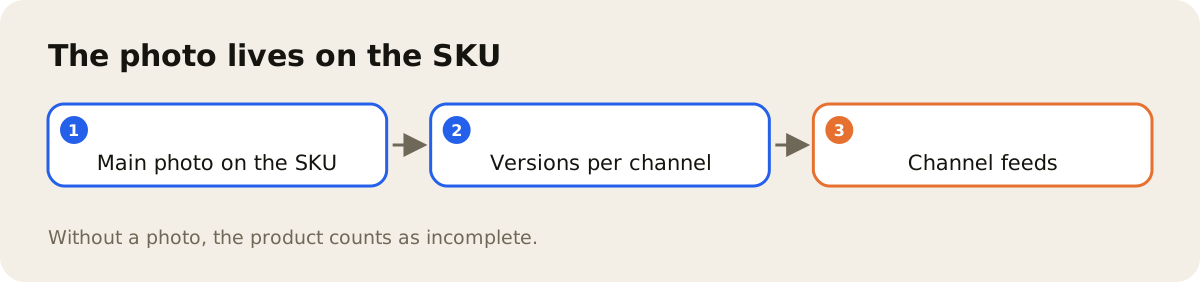
The alternative is to treat the image as part of the product, rather than a file that lives somewhere else. The photo belongs to the SKU. The manual belongs to the product. When data and media live under the same roof, the link stops being a chore and becomes part of the structure.
This has practical consequences:
- Completeness requires the media. A product without a photo shows up as incomplete on your dashboard, before anyone publishes.
- Replacing a file rebuilds the versions. When you replace the main image, the versions in each channel's size are generated again from it.
- The gap shows up on the product. "Which products have no photo?" stops being an audit across two tools, because the missing image shows up in each product's completeness.
The payoff is reliability
The value of putting PIM and DAM together is making fewer mistakes: fewer incomplete products, fewer swapped photos, fewer "why did this go live like that?"
In AdCore Turbo, the photo is an attribute of the SKU, completeness requires the image, each replacement is recorded in an audit trail, and the PDF manual stays on the SKU itself, searchable by its text. The feeds for the channels come from that same product record.
The same patchwork cost appears when the feed generator also sits in a separate system, and the post on the Product Data Hub covers the three layers together. The path from the product record to each channel is in how modern feed management works.