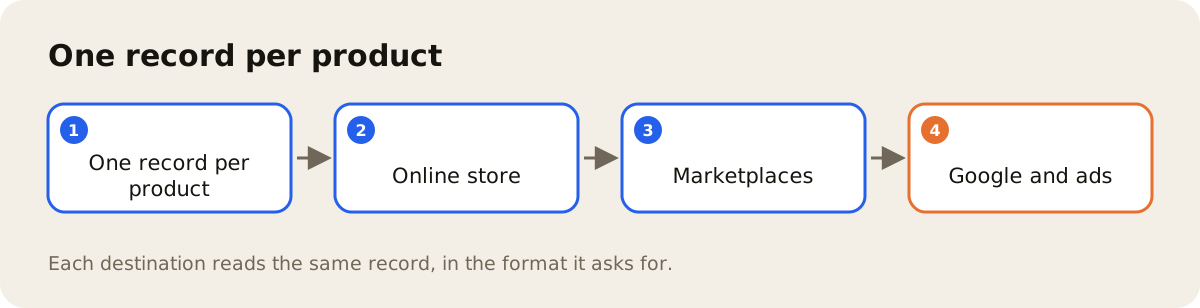
A product data hub is the place where each product has a single record, with attributes, price and media, that the store, the marketplaces and the ad channels all read from. You fix the product once, in the record, and the next publication to each channel goes out with the corrected data.
The average Brazilian retailer sells the same product in many places at once: its own e-commerce site, two or three marketplaces, Google Shopping, the paid media catalog. Each of these destinations wants the data its own way. One requires a GTIN, another requires a category from its own tree, a third rejects the photo if it is not the size it asks for.
On Google, for example, the product data specification marks each attribute as required, optional, or dependent on the product and the country, and the Merchant Center image rule asks for a minimum size and an image with no promotional elements over it.
In practice, product data ends up scattered. A spreadsheet for the marketplace, an XML file for Google, a folder of images on Drive, a description field that someone copied and pasted in a hurry. When the price changes, it changes in one place. When the photo improves, it improves in one place. The rest stays outdated until someone notices, and that almost always happens after sales have dropped.
The hub reverses the logic
A Product Data Hub does the opposite: the channel stops being the place where data gets fixed and only reads the record.
This changes three things:
- Consistency. The same product stops having a different description in every spreadsheet, because there is only one description to maintain.
- Speed. A new product is set up once and goes out formatted for each destination, instead of turning into ten data entry tasks.
- Governance. You see in one place what is complete, what is waiting for approval and what cannot go live yet.
Separate PIM, DAM and feed tools cost you in the gaps between them
The temptation is to solve each problem with its own tool: a PIM for the attributes, a DAM for the images, a feed generator for the channels. The problem shows up in the gaps. Three systems that do not know each other hold three versions of the same product, and the inconsistency comes back through the back door.
In a hub, structured data, media and distribution tell the same story. The photo belongs to the product. The map to the Google category belongs to the product. The completeness that says whether the record is ready belongs to the product. Keeping these together is what makes the operation predictable.
Is a product data hub the same as a PIM?
The two overlap, but the hub goes further. The PIM handles the structured product data: attributes, texts, spec sheet, approval. The hub adds to that record the media linked to the SKU, which is the DAM's role, and the output to the channels, which is the feed's role.
The PIM and DAM part is detailed in PIM and DAM in the same place, and the output to the channels in how modern feed management works.
When the hub starts to pay off
The hub pays off when the number of channels grows. Each new channel raises the cost of maintaining the data by hand, and the spreadsheet that worked for two destinations does not work for six. It is also worth remembering that search engines and AI assistants read the published catalog: bad data can become a wrong answer about your product in front of the customer.
AdCore Turbo was built around this idea. The product record with approval and version history, the photo linked to the SKU and the feeds to the channels live in the same place, and the AI proposes texts that someone on your team approves before anything is saved.
What retailers need is one place where product data stops contradicting itself, rather than one more tool in the stack.