To write product descriptions with AI without introducing errors, give the model the attributes from the product record, treat the generated text as a proposal, and have a person check measurements, voltage and claims against the spec sheet before publishing. Keep the previous version and measure the effect on the channel before rolling it out to the whole catalog.
The catalog has three thousand products, and a thousand of them still carry the supplier's description: one line, sometimes in all caps, sometimes in Spanish. Rewriting them all by hand would tie up the team for a long time. Generating them all with AI is fast. The temptation is obvious, and so is the risk: a language model writes fluently and confidently even when it invents the capacity, the voltage or a feature the product does not have.
AI can bring real gains to a catalog. What separates a gain from a problem is the process around it.
What AI does well in a catalog
- Turning data into text. With the right attributes in hand (capacity, material, dimensions), AI writes a readable description that is consistent with them.
- Standardizing tone. A thousand descriptions from a thousand suppliers get the same voice.
- Proposing what is missing. Starting from the existing text, it can suggest attributes the family calls for that are still empty.
- Writing variants of a field. Search title, short description, meta description.
Where does AI go wrong in product descriptions?
- It invents technical data. If the voltage is not in the product record, the model may assume one.
- It overpromises. Adjectives and guarantees that no product document supports.
- It copies the product next door. Similar products get nearly identical descriptions, which helps neither the shopper nor search.
- It gets the product category wrong. An accessory described as the main product.
All of these errors have the same root: the text was published without anyone checking it against the product data.
Channels run their own checks. The Google Merchant Center description rule asks that the text describe only the product and bans promotional text, such as price, shipping or discounts. The title rule asks that the title describe the product shown on the landing page. Both fields travel together in the Google product feed.
A process that works
- Product record first. The AI works from the attributes. The more complete the record, the less room for invention.
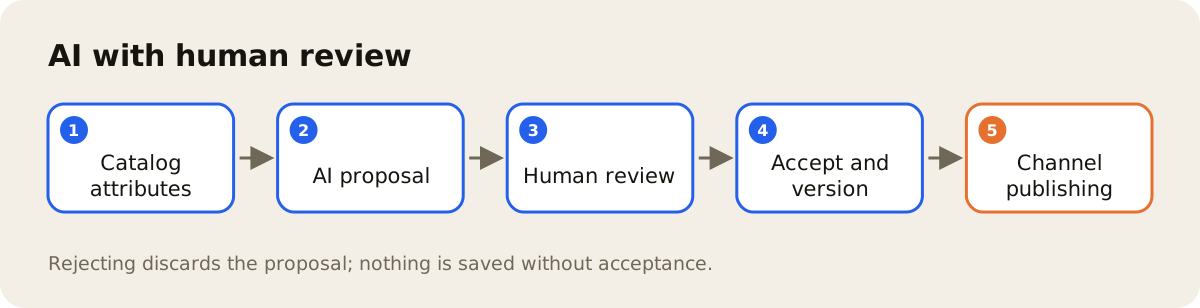
- Suggest first, save later. The generated text stays as a suggestion, next to the current text.
- Human review with criteria. The reviewer checks measurements, voltage and any performance claim against the spec sheet. Bulk approval is fine when the sample you checked is clean; publishing without anyone looking is not.
- A change log. Keeping the previous version lets you roll back if an error slips through.
- Measure. Track what the change did to the channel's metrics before rolling it out to the whole catalog.
If the attributes are still incomplete, the first step is the attribute dictionary by family.
AI in AdCore Turbo, with human sign-off
In AdCore Turbo, AI for catalogs proposes a description, an SEO title and a meta description in Portuguese, and suggests attributes that are missing from the product's family. Everything arrives as a proposal, next to the current text: nothing is saved until someone on your team accepts it. Teams that prefer not to use AI can turn it off for the account.
The goal is to describe the entire catalog much faster than by hand without publishing a sentence the product cannot back up. The product record that feeds this process lives in the PIM.